Gu Kaizhi ate sugarcane from the tip: how solar-term eating is returning to the table
China's solar-term food tradition is being picked up by twenty-somethings through community fairs, herb tea cafés and gift boxes, not lectures.
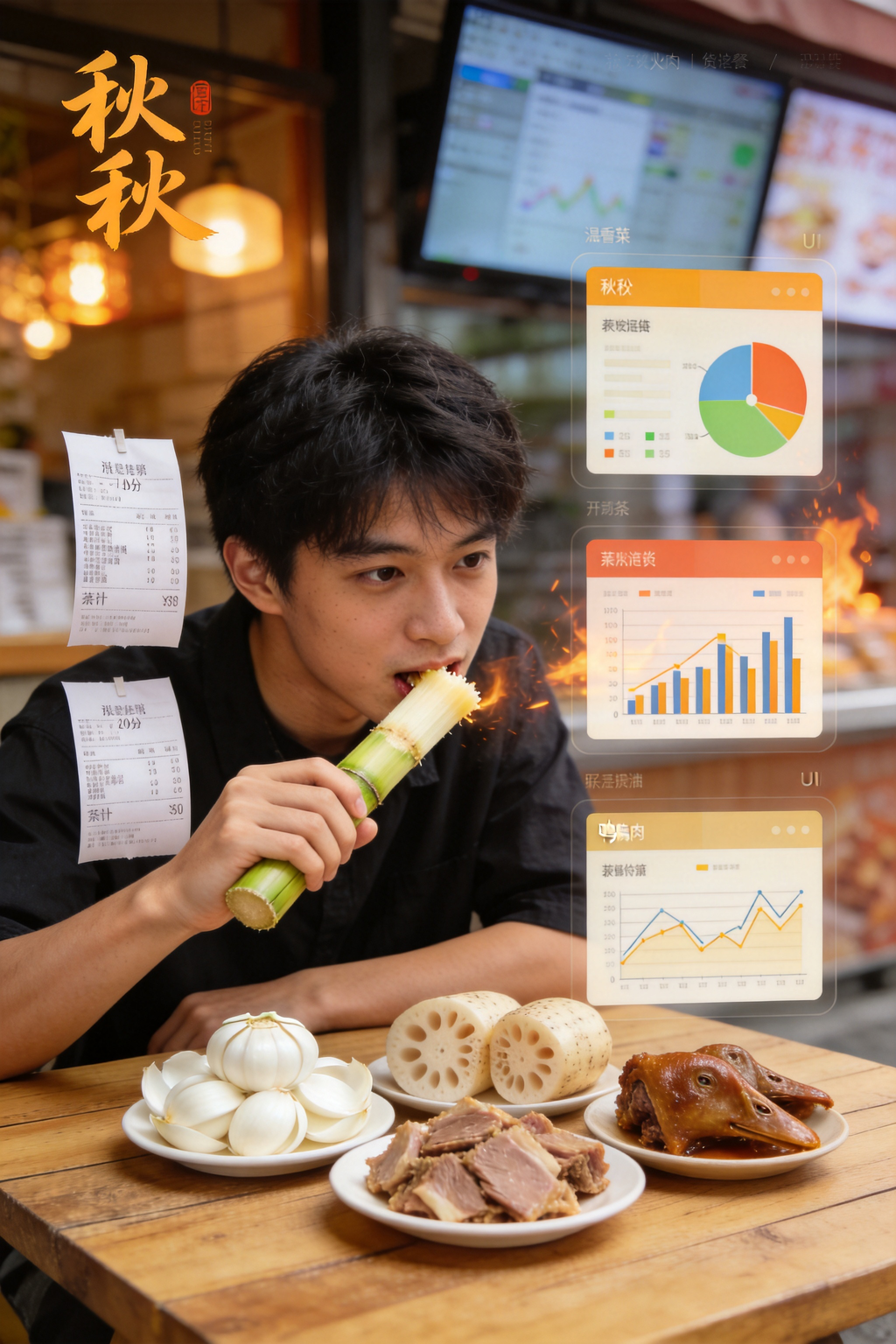
Autumn Equinox has just passed, and lily bulb, lotus root and duck — the "white ingredients" — are being discussed again. The more interesting story is not the eating itself, but the tradition of eating around the solar terms, which people in their twenties are picking up again, in their own way.
The core of solar-term eating is Gu Kaizhi's way with sugarcane
The point of solar-term eating was never a checklist of what to eat, but a habit of eating according to time.
The story starts in A New Account of Tales of the World (Shishuo Xinyu), in the "Paitiao" chapter. The Eastern Jin painter Gu Kaizhi, eating sugarcane, always began at the least sweet, least juicy tip and worked section by section toward the root. Onlookers found it odd. His answer was four characters: jian zhi jia jing — gradually reaching the finest state.
Each section is sweeter than the last; you move slowly into the best of it.
The story later became an idiom, and it explains the temper of solar-term eating: you do not hear that something is good and eat your fill of it at once, but follow time, from mild to rich.
After Autumn Equinox, a NetEase subscription seasonal-living piece gathered the old sayings into "one to sun, two to guard against, three whites to eat." The three whites are duck, lily bulb and lotus root. On lily bulb, the piece uses the phrase "this lily bulb of medicine-food homology," cooked with egg; on lotus root, it calls it the "water-spirit root," both vegetable and medicine, fine stir-fried or in soup. These describe traditional uses of ingredients, part of dietary habit.
The south runs on another line. Fujian and Guangdong sit by the sea and prize original flavour — steaming, blanching, little oil and salt. The ershisi wei (twenty-four-ingredient) herbal tea in street-side shops is a shared memory across generations, and some stalls insist on brewing it with honey, carrying the bitter and the sweet themselves.
This is not a wellness class. It is a local history of taste.
How younger people are taking it over, differently from their elders
It is not that young people reject the solar terms. They have swapped "reading the almanac" for "showing up."
On 27 September, the Luxihe community of Longquan Subdistrict, together with the Longquan Yi District Muzi Social Work Service Centre, held a "Children Celebrate the Founding, Elegant Garden Gathering" solar-term parent-child fair at an outdoor site in the Xishan Lantai residential compound, with 60 parent-child families taking part. There were no lectures: the event had three sections — stamp-card interaction, traditional games and stamp collection for redemption — including red-flag ring toss, Houyi Shoots the Sun, and a chopstick challenge, with six stamps exchanged for a custom gift.
The solar terms were broken into stations a parent could play through with a child.
The commercial side is visible too. Hong Kong Pak On Tong's herbal tea café in Zhuhai sits at City Balcony; by day it brews herbal tea fresh, puts chenpi (dried tangerine peel), osmanthus and Longjing into coffee for a new Chinese-style coffee, and sells Chinese whole-leaf tea; at night it switches to herbal craft beer and herbal cocktails. In one space, herbal drinks move from "something you want at a certain hour" to something present all day.
Its twenty-four-herb tea gift box comes in six varieties, including Baian Selection, Ejiao Rose Nourishing, Chrysanthemum and Cassia Seed, and Adzuki Bean and Coix Seed Light, in individual small tins, positioned for gifting, sold on JD.com.
The common thread: solar-term eating no longer spreads by argument, but through scenes that can be joined, photographed and given away.
Some say young people are just checking in for photos
The counter-argument is easy to hear: community stamp cards, café check-ins, gift boxes — lively enough, but nobody really understands the solar terms.
That judgement rests on thin evidence.
On 29 September, Xinjiang published the list of outstanding and shortlisted works for the "Health Knowledge Popularisation Action — 2026 New Era Health Science Works Solicitation" (Xinjiang region). The region received 1,567 works of various kinds. Among the shortlisted entries were titles such as The Real and Fake Monkey King on the Tip of the Tongue — Three Moves to Expose Fake and Inferior Medicine-Food Ingredients (Autonomous Region Hospital of Traditional Chinese Medicine) and TCM Regulation of Osteoporosis: Medicine-Food Homology, Eating Your Way to "Iron Bones" (Urumqi Hospital of Traditional Chinese Medicine).

Those 1,567 works were produced one by one by hospitals, disease control bodies and health education institutions across the country. Behind them is real demand for science communication, a volume that check-ins cannot sustain.
Look at the supply side the same way. Wanxingdong Pharmacy, founded in 1767, has in recent years gathered its food-as-medicine products into a single display, and according to reports has staff on hand to provide dietary-culture guidance and meal-pairing advice, while filling out its supply of food-as-medicine products aimed at younger buyers. A Xinhua report on 27 September, When AI Meets Qihuang: Higher TCM Education Embraces Technological Innovation, makes the same point: the transmission of Chinese medicine is connecting to new technical means.
Institutions are making content on one side; old names are changing their shelves on the other. To say young people only take photos is to underrate both the demand side and the supply side.
The real question is not whether they understand, but how fast the trade moves — the formulas and the solar-term knowledge are already there; can they become a scene young people are willing to walk into?
What this suggests for operators
For people in this trade, two things on this stretch of road are worth watching.
The solar terms themselves can serve as a product rhythm. Autumn Equinox points to lily bulb and lotus root; the south points to herbal tea — ready-made seasonal hooks, less effort than inventing a concept. Choose products by solar term and you have twenty-four natural reasons to push over a year.
Scenes are worth more than sermons. Pak On Tong puts its weight on places where people can sit down: its offline experience store takes the Zhuhai City Balcony branch as its model, alongside e-commerce flagship stores and a private-domain mini-program, keeping scan-to-order, membership and orders in its own hands. For anyone preparing to enter, this order — store first, goods second, private domain last — is steadier than hanging up an e-commerce link alone.
Closing
Gu Kaizhi ate his sugarcane a section at a time, each sweeter than the last. The solar-term food business is the same: it cannot be rushed — give the timeline to the solar terms, give the scene to young people, and the rest is a slow chew.
Experience store, e-commerce store and mini program support.