
A Guangdong herbal tea brand skipped its home region and opened in Chengdu SKP
Qu Chao Ku Shui opened first in Chengdu SKP, not Chaoshan. What its site choices reveal about price band, footfall and repeat purchase in herbal retail.
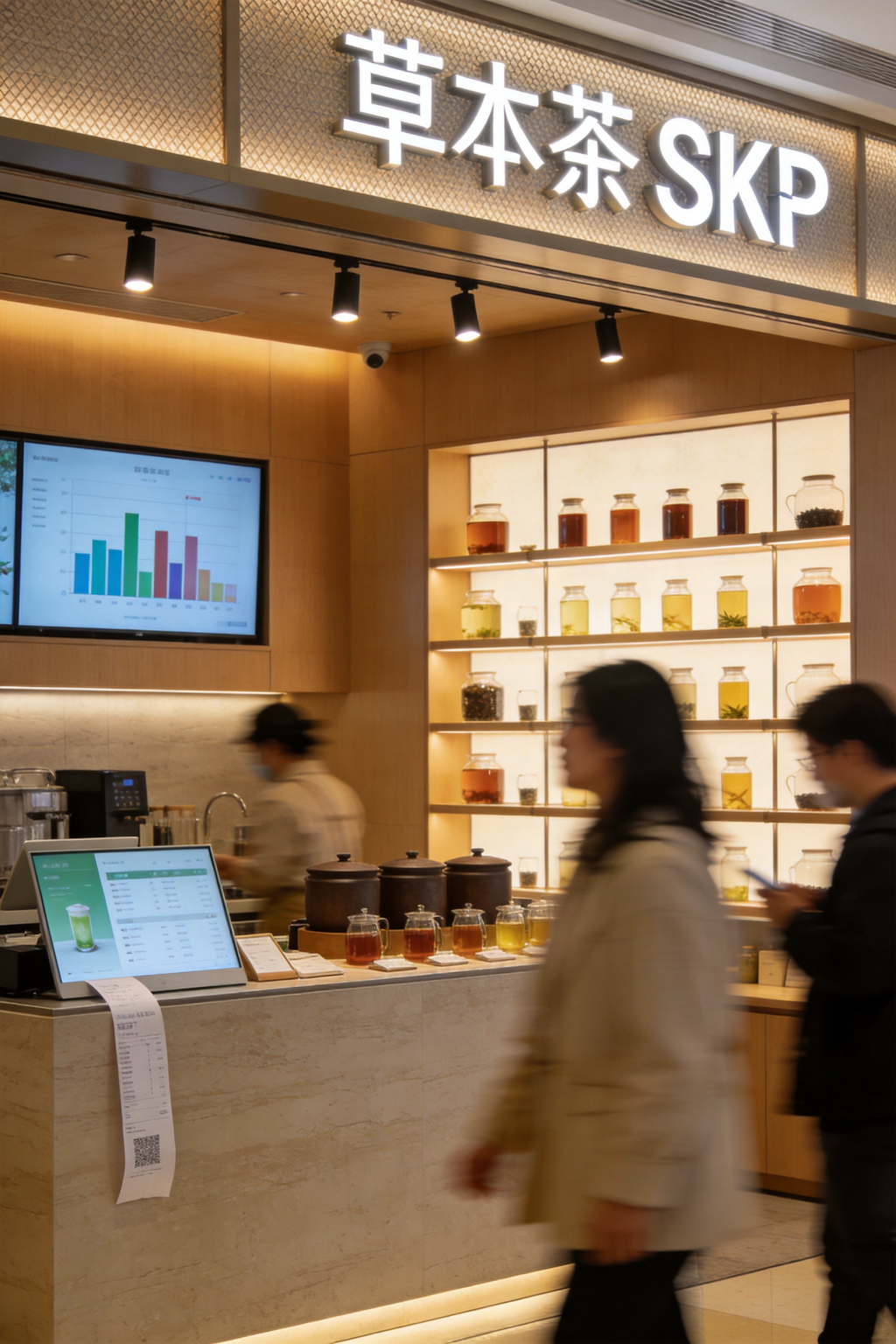
Qu Chao Ku Shui is a herbal tea (liangcha) brand founded in 2024. It did not open its first store back in Chaoshan, the region in eastern Guangdong where herbal tea culture is strongest. It went to Chengdu SKP instead, and later to Taikoo Li Qiantan in Shanghai.
For anyone scouting a site for a herbal tea or tonic business, the useful question is not why a cup of herbal tea can carry that price. It is the older question the brand has put back on the table: when you choose a location, are you buying footfall, or are you buying a group of people who recognise this cup and will pay for it?
The site itself is a pricing decision
Many stores do not fail because they sell the wrong thing. They fail because they sell the right thing in the wrong place — the price band and the location do not match.
In an interview with Qu Chao Ku Shui for the Winshang "Dialogue with New Forces" series, the brand gave a direct reason for its site choices: it did not return to Chaoshan first, because in places where the understanding of herbal tea is already fixed, cultural premium is harder to see. In newer consumer settings where people will pay for story and experience, Chaoshan culture draws attention precisely because it feels unfamiliar.
The three stores carry separate names — the Chengdu SKP store is called "Chaosu Jinjiang", the Shanghai Taikoo Li Qiantan store "Dongfang Liangjing", and the Shanghai BFC store "Ganrun Dongfang". The brand sums this up in four words: the channel is the positioning.
The same cup of herbal tea is not the same product in a neighbourhood ground-floor unit and in Chengdu SKP. The first sells thirst relief and habit; the second sells experience and a sense of identity. Pricing power differs, and so does the product mix, staffing and pace of service each can support.
The community-store maths is sound, but the ceiling is built into it
An industry analysis republished by Sina Finance laid out the single-store model for wellness tea drinks: opening independently takes roughly RMB 100,000 to 150,000 to get started; ingredient cost per cup is mostly RMB 3 to 5; wellness fruit and vegetable juices and floral tea drinks commonly retail above RMB 22 per cup; after deductions, gross margin is generally 60 to 70 per cent.
By that article's estimate, the cost structure is roughly 25 to 30 per cent raw materials, 20 to 30 per cent rent, 20 to 25 per cent labour, 5 to 8 per cent utilities and sundries, with net profit of 15 to 30 per cent. A single store doing RMB 50,000 to 80,000 in monthly sales nets about RMB 10,000 to 20,000.
These figures show the community model can work. But the same analysis notes three other things: trends arrive fast, and within half a year similar stores flood the market; the business is clearly seasonal, with warm drinks selling in winter while hot drinks alone leave summer quiet; and small-scale operators typically pay 30 to 50 per cent more than large brands for raw materials. Once a second or third store is added, supply stability, cost control and food safety testing costs rise sharply.
In other words, low rent does not buy lower operating risk. It buys a revenue ceiling fixed in advance. The analysis itself notes that stores in communities and beside primary schools "barely hold on through group buying and repeat purchase" — the footfall ceiling for a single store is simply where it is.
"Slow business belongs in the community" misses one variable
The common counter-argument runs: wellness tea is a trust-driven, slow business, so it belongs in communities and beside schools, serving regulars, rather than paying rent to a landlord in a core commercial district.
That holds inside a single-store model, but it assumes repeat purchase is the only variable, reducing site selection to a rent comparison.

In fact, a low-rent location filters for customers with high visit frequency, low spend per visit and price sensitivity. A mall location filters for customers whose frequency may not be high, but who are not price sensitive and will pay for experience. These are two different businesses, not a premium and budget version of one business.
The cost of a mall store is equally clear: higher rent, less room for error, and the need to earn that rent back through pricing power and cultural distinctiveness. In its interview, Qu Chao Ku Shui said it deliberately keeps a moderate bitterness and explicitly does not make sweet drinks — itself a way of filtering customers. Different paths, no ranking, only fit.
What this means for operators
Set the price band first, then the site. Do not start with which street has more people. Start by answering three questions: what price is this cup meant to sell at; who buys it and at what time of day; and in the quietest month of the year, can this location still hold.
Do not compare community stores and mall stores on the same cost sheet. What you get is not a ranking but a wrong conclusion.
Trading hours can be used to spread rent. PAKONTONG currently has only one physical store — the City Balcony store in Zhuhai. By day it brews herbal tea fresh, makes new-style Chinese coffee using chenpi (dried tangerine peel), guihua (osmanthus) and longjing (Dragon Well tea) in coffee, and serves Chinese whole-leaf tea. After dark it shifts to herbal craft brews and herbal cocktails. One site, three different customer groups and occasions across a single day. This is its own choice, not a universal answer, but it shows one thing: rent is paid monthly, while revenue need not arrive on the same rhythm.
Gift boxes are another timeline. According to a report by Guandian, Douyin E-commerce once disclosed cumulative sales of more than 12 million orders during its Spring Festival shopping event, with brand gift box sales growing threefold. The point of seasonal business is not that month's volume, but whether it can pull in people who never visit the store at other times. The precondition is that the product itself holds up — packaging solves the first purchase, repeat purchase solves the second year.
Site selection should not answer "where are there more people" but "who will buy this cup a second time here". The first purchase depends on location. The second depends on what the location itself cannot provide.
Experience store, e-commerce store and mini program support.