Bozhou's solar-term banquets show how China's seasonal eating tradition is being picked up by younger diners
A 500-dish medicinal menu and a solar-term banquet in Bozhou point to how China's 24 solar terms are moving from calendar entries to restaurant menus.
Solar-term eating was long filed under the habits of an older generation. This National Day, Anhui's Bozhou turned it into what visitors called a "must-eat while travelling": according to an October 5 report by Xinhua, a local medicinal-diet restaurant has developed more than 500 dishes and staged a "solar-term banquet". We read this as the 24 solar terms shifting from a noun on the calendar to something actually happening at the table — a signal worth revisiting for anyone in the food-as-medicine business.
The solar terms govern when to eat what, not what to supplement
Some background first. The 24 solar terms began as an agricultural timetable, marking shifts in sunlight, temperature and rainfall. Applied to food, they reduce to a plain idea: eat what grows in the season. In traditional dietary practice, the "solar term" is at heart a roster of produce, not a year-round checklist of tonics to tick off.
That order has its own sense of rhythm. According to a local vendor's public account information, a herbal tea (liangcha) stall at Bukit Mertajam's Tua Pek Kong Cheng in Malaysia has run since 1967, staffed throughout by three grandfathers; a stew shop in Batu Pahat, Johor, dating from 1978, sets its rest days on the first and fifteenth days of the lunar month. No hawking, no overtime, days that follow the calendar — the folk original of the solar terms looks closer to this blunt method of "start on time, stop when the time passes" than to the various refinements packaged around it today.
This National Day, Bozhou made the solar terms a "must-eat"
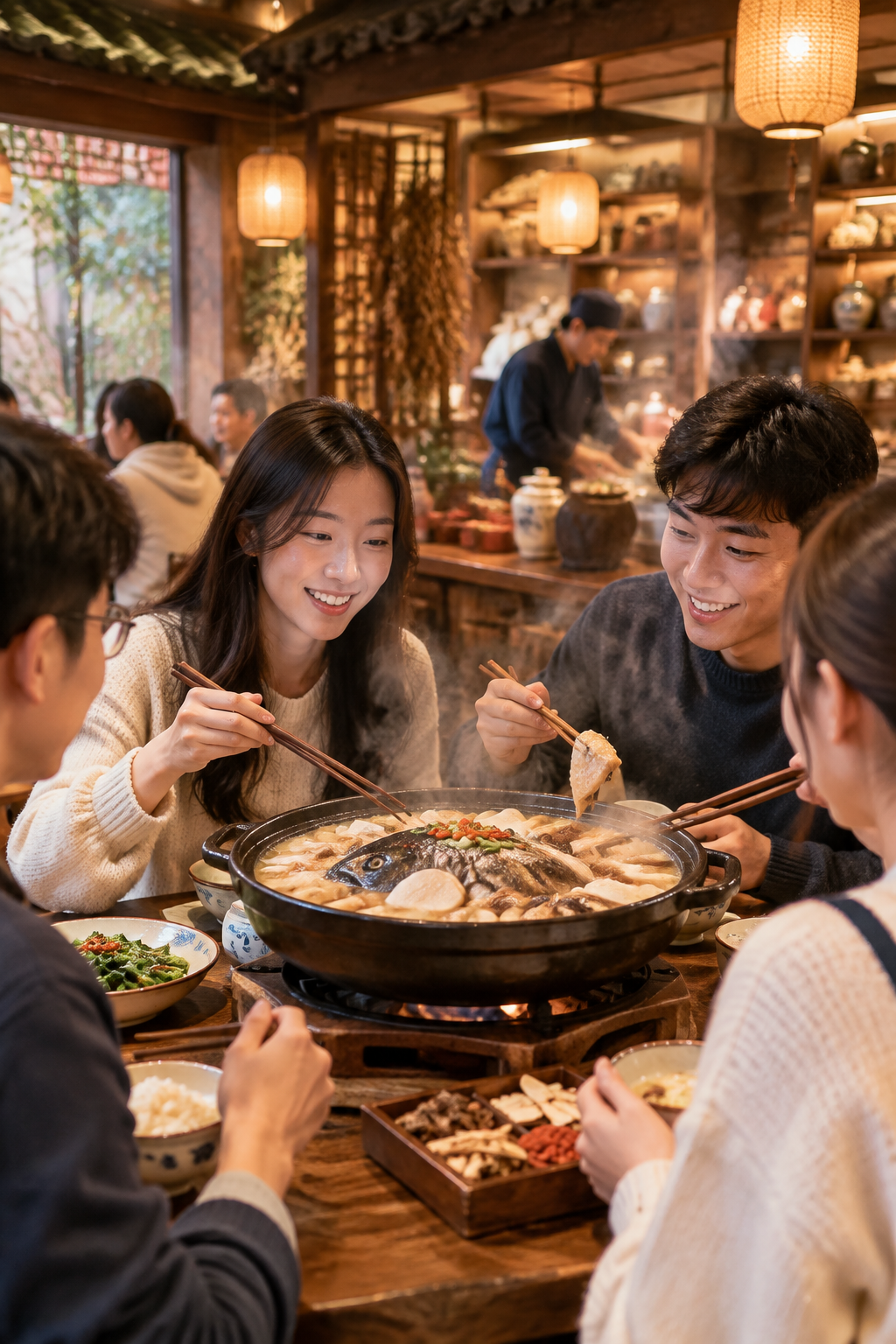
According to the October 5 Xinhua report (reporter Zhu Qing), in Bozhou over the National Day holiday "Cao Cao fish head" bubbled to the table at the medicinal-diet restaurant Huaiyangtang, the aroma of tianma (gastrodia) and fuling (poria) mixing with the savour of silver carp head; the dish has sold more than 400,000 portions. Huaiyangtang has developed more than 500 medicinal dishes in total and has also staged a "solar-term banquet". At another establishment, Huashanlou, a "Du Zhong Cao Cao chicken" with sales of over a million portions sat on the display stand, waiters explained the dish's story to foreign visitors in English, and the shop launched a "Bozhou medicinal diet ten bowls" while preparing to build a medicinal-diet museum.
The same report covered several other places: Jiangnan Medicine Town in Pan'an, Zhejiang, where Chinese herbal wellness milk tea has become a new choice for young people; Luotian in Hubei, where combinations traditionally used as ingredients — fuling and tianma fish head soup, braised pork with du zhong (eucommia bark) — have been folded into medicinal-diet experience tours; and Wuduo Mountain in Nanzhao, Henan, which has simply put a medicinal-diet kitchen and a herb garden inside its homestays. The report noted that during the long holiday a national National Day culture and tourism consumption month was launched, with more than 20,000 culture and tourism events and over 310 million yuan in consumption vouchers and other subsidies.
In one line: solar-term eating is not a heritage put on a shelf. It circulates in the most worldly way — as tickets, menus and foot traffic.
"Young people won't buy it" is only half right
The usual counter-argument runs: solar-term eating is an elder's ritual, young people won't have it, and the fuss dies down after a few days.
We think that judgement confuses "won't buy it" with "won't buy it on the old terms". Young people do not sit down to a full solar-term banquet — true enough. But they will order a Chinese herbal wellness milk tea while travelling, make a special trip to Bozhou for a photogenic meal, pick a sprig of mint in a homestay herb garden. The act of consumption has changed; the underlying sense of time has not — they still care whether a thing belongs to this season.

What actually disperses was never the solar terms, but the practice of borrowing their name while selling the same goods in all four seasons. Bozhou works because local herbs, local stories and seasonal ingredients bite into one another; copy the menu in another city and it will mostly fail.
What it means for operators
The greatest value of the solar terms for a shop or a product line is the rhythm of renewal it supplies for free — twenty-four reasons a year to adjust the menu, the shelf and the content, without inventing occasions. But the solar terms speak of what suits this moment; the product still has to solve what is convenient at this moment.
Here the approach of the PAKONTONG Herbal Tea & Coffee store at City Balcony, Zhuhai, is worth noting: by day it serves freshly brewed herbal tea, placing new-Chinese coffee made with chenpi (dried tangerine peel), guihua (osmanthus) and longjing alongside Chinese whole-leaf tea; at night it switches to herbal craft brews and herbal cocktails — one herbal theme, changing form across the hours of a day. Its twenty-four-herb tea gift box comes as six varieties in individual small tins, sold on JD.com, linking "drink in store" and "brew at home" as two legs. The underlying logic is plain: solar-term culture supplies the reason, product form makes it doable.
The solar terms will not sell your goods for you. They only remind you when to change them.
Experience store, e-commerce store and mini program support.