China's food-as-medicine list now covers 106 ingredients, but it is not a licence to make claims
China's catalogue of substances that are both food and traditional medicine has reached 106 items. It governs what you may use, not what you may claim.
China's catalogue of substances that are traditionally both food and Chinese materia medica reached 106 entries as of May 2025. For anyone opening a shop or selling goods, the list is often read as a product-sourcing guide. What it actually governs is something else: which ingredients you may use is a separate question from what you may say about the product.
The catalogue widens the ingredient boundary, not the space for claims
Start with where this round of expansion lands.
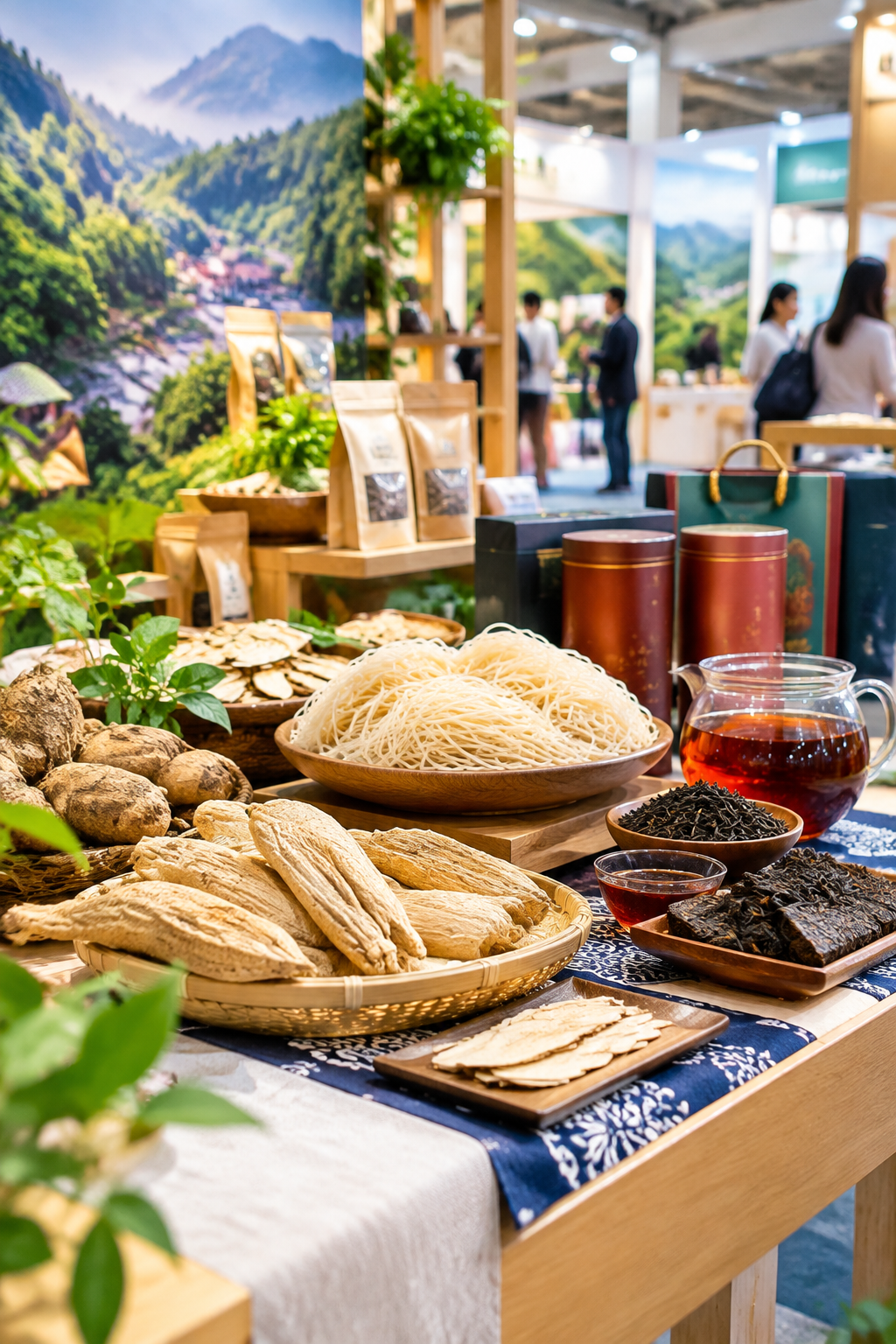
From 28 September to 2 October 2026, the Zhejiang Provincial Chinese Materia Medica Expo was held in Pan'an, Jinhua, with roughly 40,000 square metres of exhibition and sales space. More than 150 companies took part, among them Tongrentang, CONBA, Shouxiangu and Tongjuntang. Products on show included huangjing (Polygonatum) black tea, gastrodia noodles, a "five-black" herbal congee and raspberry pressed candy (source: Xinhua). At the same time, eight projects were signed, covering areas such as new quality productive forces in internet healthcare and the digitalisation of traditional Chinese medicine.
The shelf really is filling up, and the goods look more like everyday consumer products. Gastrodia turned into noodles, huangjing turned into black tea — this pulls medicinal materials in the direction of ingredients. That is the point of expanding the food-and-medicine substances catalogue: to give long-standing eating habits a clear identity.
But a clear identity does not mean you can say whatever you like.
The catalogue settles whether something can be used as a food ingredient. It does not settle whether that something can be described as having an effect on people. A great deal of trouble in shops comes from that second step.
The regulator's hand is moving toward labels and testing
In September 2026, the State Administration for Market Regulation issued 13 rapid food testing methods, including a colloidal gold immunochromatographic method for rapid detection of triazophos in vegetables and fruit. Alongside this, for the illegal addition of non-food substances to food, it issued toxic and harmful substance determinations and enforcement testing methods for vonoprazan and its series of derivatives, and for torasemide and its series of derivatives, providing technical support for frontline regulatory enforcement (source: Zhongshi Anxin September regulatory review). In the same month, several food safety standards, including one for milk protein, and a question-and-answer document on infant formula labelling were released.
Another track is additives. On 10 September 2026, the China National Center for Food Safety Risk Assessment opened public consultation on new food nutritional fortifiers — 3-fucosyllactose and 6'-sialyllactose sodium salt — and on expanded use ranges for curdlan and sanzan gum, among others (source: Centre Testing International, Special Food Monthly Bulletin, September 2026).
Standards are getting finer, testing is getting faster, and problems can now be traced. The room that once existed for getting by on vagueness is being filled in, method by method.
The counter-argument deserves a proper rebuttal
A common judgement in the trade runs like this: as long as you do not write "what it treats", and instead swap in words like "nourish", "support", "clear" or "smooth", you have not crossed the line.
We think that judgement does not hold. Whether a claim about ordinary food crosses the line does not turn on whether a handful of sensitive words appear. It turns on whether, after reading it, a consumer would believe the product produces some kind of regulatory effect on bodily function. Changing the wording does not solve the problem; the same substance under a new label is still treated the same way.

At the other extreme is deleting traditional ways of eating altogether — which is unnecessary. The Huangdi Neijing, the classic inner canon of Chinese medicine, says that taken on an empty stomach it is food, and taken by the sick it is medicine: the same set of things, two uses. Using an ingredient traditionally in soup, in tea or in cooking is part of food culture and can be described — but the description must be complete: this is traditional dietary practice, not a functional promise.
What has to be held is the boundary. Ordinary food does not discuss function. To discuss function, you must go through the registration route for health food and obtain the "blue hat" approval. Above and below that line are two different games.
What this means for operators
Check the catalogue before you choose a product. Whether an ingredient sits on the list of 106 is the precondition for putting it on a shelf. Do not wait for a spot inspection to discover you are selling something with an unclear identity.
Keep your wording consistent too. Menus, packaging copy, mini-program product pages, what staff say at the counter, private-channel messages — if any one of these describes the food as something else, the compliance work done everywhere else is wasted. In shops, the likeliest source of trouble is a member of staff's mouth, not the label.
One more point: rather than selling an effect, sell an occasion. PAKONTONG's approach is worth a look here. Its twenty-four herb tea gift set comes in six varieties, in individual small tins in a premium gift box, sold on JD.com. Its Zhuhai City Balcony store serves freshly brewed herbal tea and new-style Chinese coffee (with chenpi, osmanthus and longjing folded into the coffee) and Chinese whole-leaf tea during the day, and herbal craft brews and herbal cocktails after dark. It does not explain what the herbs "do". It puts different hours of the day in front of the customer: what to drink in the morning, in the afternoon, in the evening.
The occasion itself is the safest form of expression.
A list of 106 items widens the boundary of ingredients. How far you can go depends on whether you keep what you say inside the range where it belongs.
Experience store, e-commerce store and mini program support.