What "Lijiuwei" Means for Anyone Selling Herbal Tea
Lishui's new regional brand names nine local herbs and 21 member firms, while Beijing moves to test whether labels tell the truth.
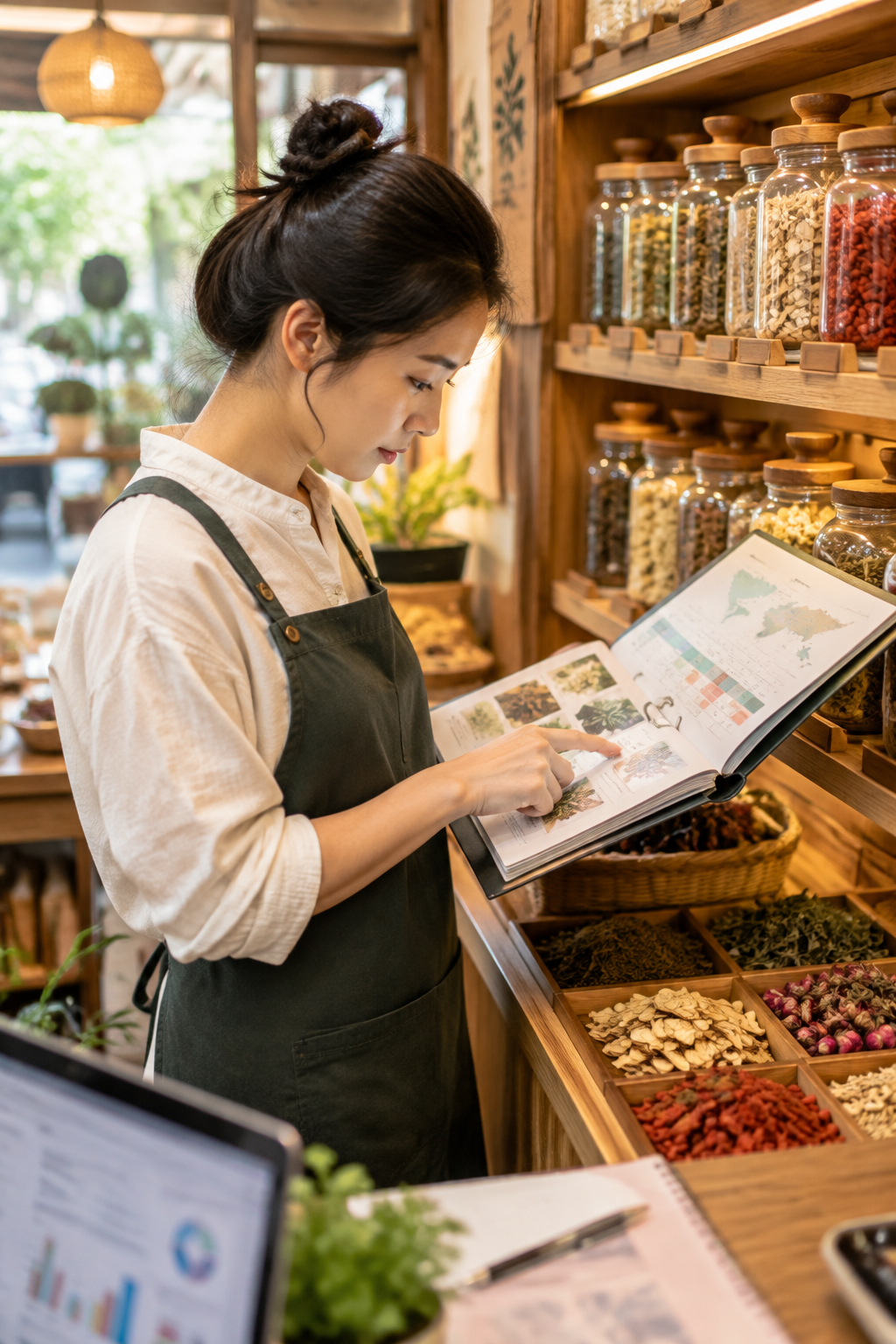
Suppose you run a herbal tea shop. Your supplier's new catalogue arrives with an extra column: place of origin.
Where you once chose on price and aroma, there is now another field to fill in.
In April 2025, the city of Lishui in Zhejiang province launched "Lijiuwei", a regional public brand that packages nine Chuzhou herbs — lingzhi, tiepishihu, sanyeqing, huangjing and others — into a single local identity. For January to July 2026, the city reported industrial output of RMB 9.743 billion from above-scale TCM health enterprises. Upstream is being renumbered, and the logic of sourcing has to adjust with it.
What a place does first is identity, not price
The conclusion first: when a region builds a public brand, what it governs is not what things sell for, but who is allowed to put the place name on them.
Lijiuwei is Lishui's selected list of daodi herbs — herbs grown in their recognised native place — formally released in April 2025. According to local reports, 21 companies including Zhejiang Shengshengtang Guoyao Group and Zhejiang Wuyangtang Pharmaceutical became founding members, with 44 products launched alongside, among them huangjing instant drink granules and sanyeqing powder. The nine are lingzhi (reishi), tiepishihu (Dendrobium officinale), sanyeqing, huangjing (Polygonatum), fupenzi (raspberry), Chuzhou white lotus seed, shiliangcha, yiyiren (coix seed) and huangju (imperial chrysanthemum).
For anyone making herbal teas, flower blends or tonic gift sets, the value of this list is not that there is one more brand. It is that the purchasing coordinate becomes clearer: these nine herbs, grown in Chuzhou, supplied by names on the list.
Lingzhi, tiepishihu and huangjing have long appeared in herbal blends. Gathering them under one public brand pushes the question of what a given herb actually is one step beyond word of mouth.
The testing side is digging in too
The brand moves upward; testing moves downward. What sits between them is the same thing: what the label says has to match.
On 16 June 2026, the State Administration for Market Regulation published its 2026 list of open-call projects for supplementary food testing methods, seeking nationwide submissions in three areas: identification and quantitative determination of adulteration in alcoholic products, including systematic identification of exogenous ethanol and exogenous colour, aroma and flavour substances in baijiu; identification and quantitative determination of other animal or plant-derived material in milk and dairy products, such as cow's milk in goat's milk; and identification and quantitative determination of adulteration in condiments, such as other hydrolysed proteins in soy sauce.
Applications closed on 20 July 2026, with a development period of one year in principle. Funding is paid after the fact, released in a single instalment once acceptance is passed.
The list does not name herbal tea. But the direction is plain: whether a declared ingredient is genuine is moving from a master's taste and glance to a method that can be quantified.
Anyone blending herbs, flower teas or compound ingredients should think ahead: the few items on an ingredient list will, from here, need to hold up to testing.

How deep the foundation runs decides how long the business lasts
Now the industry side. Lishui has formed a distinctive cluster represented by TCM decoction pieces, Chinese patent medicine preparations, plant extracts and health products, with companies including Weikang Pharmaceutical, CR Sanjiu Zhongyi, Guojing Pharmaceutical and Fangge Pharmaceutical. Local industry reporting lists "the continued expansion of the catalogue of food-and-medicine substances such as lingzhi, and the broad space for developing food-as-medicine products" among directions worth watching.
We think that sentence is more useful to someone running a shop than to someone running a factory. A factory looks at capacity; a shop looks at whether it can obtain goods over the long term, reliably, and with a clear account of where they came from.
When a place is willing to put effort into making daodi herbs into a public brand, it shows upstream is doing at least two things: drawing the boundary of varieties clearly, and laying out supply chain information. Those two are exactly what downstream most fears being unable to explain.
What it means for operators
- Add an "identity" column to the purchasing sheet. Origin, variety, and whether the supplier is on the local public brand or member list. The cost of recording it is low, and it saves a great deal of explaining later. Which herb you sell and where it comes from, said in one sentence, means no panic when a customer asks.
- Labels should survive being repeated back. Every item on an ingredient list is best backed by purchase receipts and batch records. Testing methods are being filled in and standards of judgement are becoming more concrete. Rather than digging through paperwork later, build the ledger from the start.
- A product line can stand on two legs. One is gift sets, one is drinks made to order. The PAKONTONG Herbal Tea & Coffee store at City Balcony, Zhuhai is worth a look: the brand idea rests on "food as medicine" (medicine-food homology), the product side is the "Twenty-Four Herbal Teas" gift set series — six recipes in individual small tins, sold on JD.com — and at the store, by day, freshly brewed herbal tea, new-Chinese-style coffee (chenpi, osmanthus and longjing in coffee) and Chinese whole-leaf tea, turning at night to herbal craft brews and herbal cocktails. What the two lines share is one thing: they do not persuade with a claim of efficacy, but with ingredients that can be repeated back and a taste you can drink.
Writing ingredients clearly and stating origin plainly is not the loudest approach, but it is the least effortful moat this business will have going forward.
Experience store, e-commerce store and mini program support.