China's 24 Solar Terms at ten: three moves from the heritage circuit for food-as-medicine brands
A decade after the 24 solar terms joined UNESCO's intangible heritage list, three recent events show how seasonal eating and food as medicine are being handed to younger audiences.
November 2016 put the 24 solar terms (ershisijieqi) on UNESCO's Representative List of the Intangible Cultural Heritage of Humanity. This November marks ten years.
Over that decade the terms have grown out of the calendar and into exhibitions, markets and community events people can handle themselves. Setting grand theory aside, here is a review of three recent real-world scenes, and what they show about how the old business of "solar terms plus food as medicine" is being picked up by younger people.
Background: the terms were always about what to eat when
Start with where the terms come from.
According to the essay The Influence of the 24 Solar Terms on Chinese Culture, the terms are not merely a calendar. They fold the rhythm of spring growth, summer expansion, autumn harvest and winter storage into farming, folk custom and daily diet: spring rolls and spring pancakes at the Start of Spring, qingtuan at Qingming, noodles at the Summer Solstice, dumplings and tangyuan at the Winter Solstice. This habit of "not eating what is out of season" is a shared Chinese memory of time, and the most everyday soil that food as medicine — medicine-food homology — grows in.
After the 2016 inscription, its status changed: from something on an old almanac to a piece of humanity's intangible heritage. Xiao Fang, a professor at Beijing Normal University, has just published Suishi: Chinese People's Time Traditions and Their Contemporary Transmission with Zhonghua Book Company, adding a chapter on "the protection and transmission of contemporary traditional festivals". His judgement: traditional festivals must hold on to their cultural roots while also being transformed through innovation.
That sentence is the annotation for the three scenes below.
Three scenes, three moves
In recent months, people working with solar-term culture have changed tack. Instead of explaining, they get visitors to use their hands, taste things, and take something home.
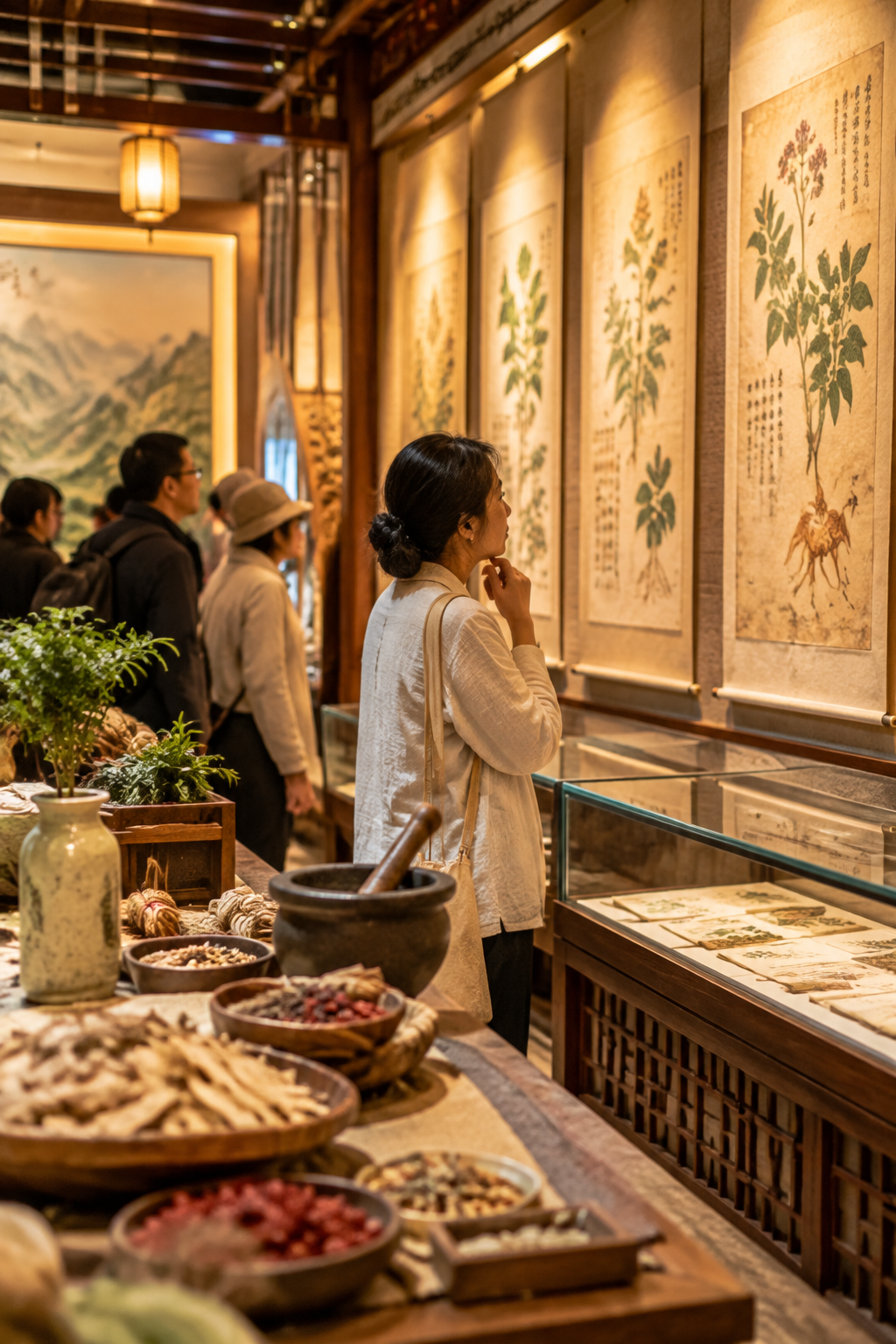
The first scene was in Beijing. According to a People's Daily Health Client report of 5 October 2026, the China National Arts and Crafts Museum is running an exhibition on intangible heritage in traditional Chinese medicine. Lines about herbs from the Classic of Poetry and the Compendium of Materia Medica have been extracted as exhibition content, alongside Tibetan medicine's mthang teaching charts and a miniature traditional medicine market modelled on the Anguo medicine market. Words from the classics turned into a space you can walk through.
The second scene was in Shanghai. On 6 October 2026, the closing ceremony of the seventh Yangtze River Delta Intangible Heritage Festival and the release of the "Top Ten Intangible Heritage Innovation Cases" were held on the century-old Grand Stage of Shanghai Great World. More than 50 organisations from Shanghai, Jiangsu, Zhejiang and Anhui registered, 20 cases were shortlisted, and ten were finally selected (Jiefang Daily, 7 October 2026). The list shows the current thinking: Wenzhou mother-of-pearl inlay linked with the film and television properties Yan Hui Shi and Yong Ye Xing He to make market-ready products; Yangzhou tongcao flower craft paired with the Chinese-style game Yi Meng Jiang Hu to explain the craft to Gen Z; the nine-fold processing technique for Chinese medicine also appears. The common thread is clear — first find where young people already are, then put your own thing inside it.
The third scene was in Zhenjiang. This year's Jiangsu Traditional Chinese Medicine Promotion Month stop in Zhenjiang was divided into zones. The intangible heritage project of herbal paste (gaofang) processing and production technique gave a demonstration of the traditional process, and the paste decocted on site drew a strong crowd. Elsewhere, ear-point application and neck and shoulder massage were on offer, with residents queuing to try them. The most valuable part of solar-term eating — handwork and on-site flavour — was brought to the front.
What came of it
One exhibition, one selection round, one city's promotion month can only tell us so much.

But the signal from all three is consistent: strong crowds, queues for the hands-on offerings, and things made on site consumed on site. Demand is not lacking; what is lacking is settings people can take part in. Talk only about "tradition" and young people will not pick it up. Put out a pot, a pair of hands and a seat to sit down on, and they come in.
What operators can take from this
If you happen to run a tea shop, work for a food brand or are preparing to enter the trade, these three scenes offer three assignments you can copy directly.
First, use the solar terms as a scheduling table, not a concept. Spring pancakes at the Start of Spring, qingtuan at Qingming, noodles at the Summer Solstice — these are ready-made moments. Twenty-four moments a year are twenty-four reasons to launch something new without hunting for a fresh justification. The terms have been on the heritage list for ten years; this timetable is shared by an entire people, so the cost of recognition is close to zero.
Second, treat experience and product as two separate jobs. The cup brewed on site keeps people there; the small pack they can take home keeps them as customers. The PAKONTONG Herbal Tea & Coffee store at City Balcony, Zhuhai offers the twenty-four herb tea gift box, which belongs to the second category: six blends — Baian Selected, Ejiao and Rose Yangyuan, Chrysanthemum and Cassia Seed Yigan, Adzuki Bean and Coix Qingying, Suanzaoren and Poria Shushui, and Ginseng and Polygonatum Tiehan — in separate small tins, made to look right for giving. The traditional habit of putting herbs into tea and soup is packed into a box you can carry away. That needs little explanation in itself.
Third, let the store carry the "on site" function. The PAKONTONG Herbal Tea & Coffee store at City Balcony, Zhuhai brews herbal tea by day and also makes new Chinese-style coffee — chenpi, osmanthus and longjing going into coffee; Chinese whole-leaf tea is there too; at night it switches to herbal craft brews and herbal cocktails. The same herbal vocabulary appears in different forms from morning to night. Young people do not need persuading; sitting down counts as taking part.
The solar terms are not contrived. They are simply the twenty-four points in a year when people already want a change of taste. Whoever catches that moment does not have to work hard to explain why they exist.
Experience store, e-commerce store and mini program support.