China's food-as-medicine list now has 106 items — what Lingzhi's home region is doing
China's food-as-medicine catalogue has grown to 106 items, bringing lingzhi into ordinary food. Here is how Lishui, its main production area, is building the supply chain.
As of May 2025, China's catalogue of substances traditionally used as both food and Chinese medicinal materials has grown to 106 items.
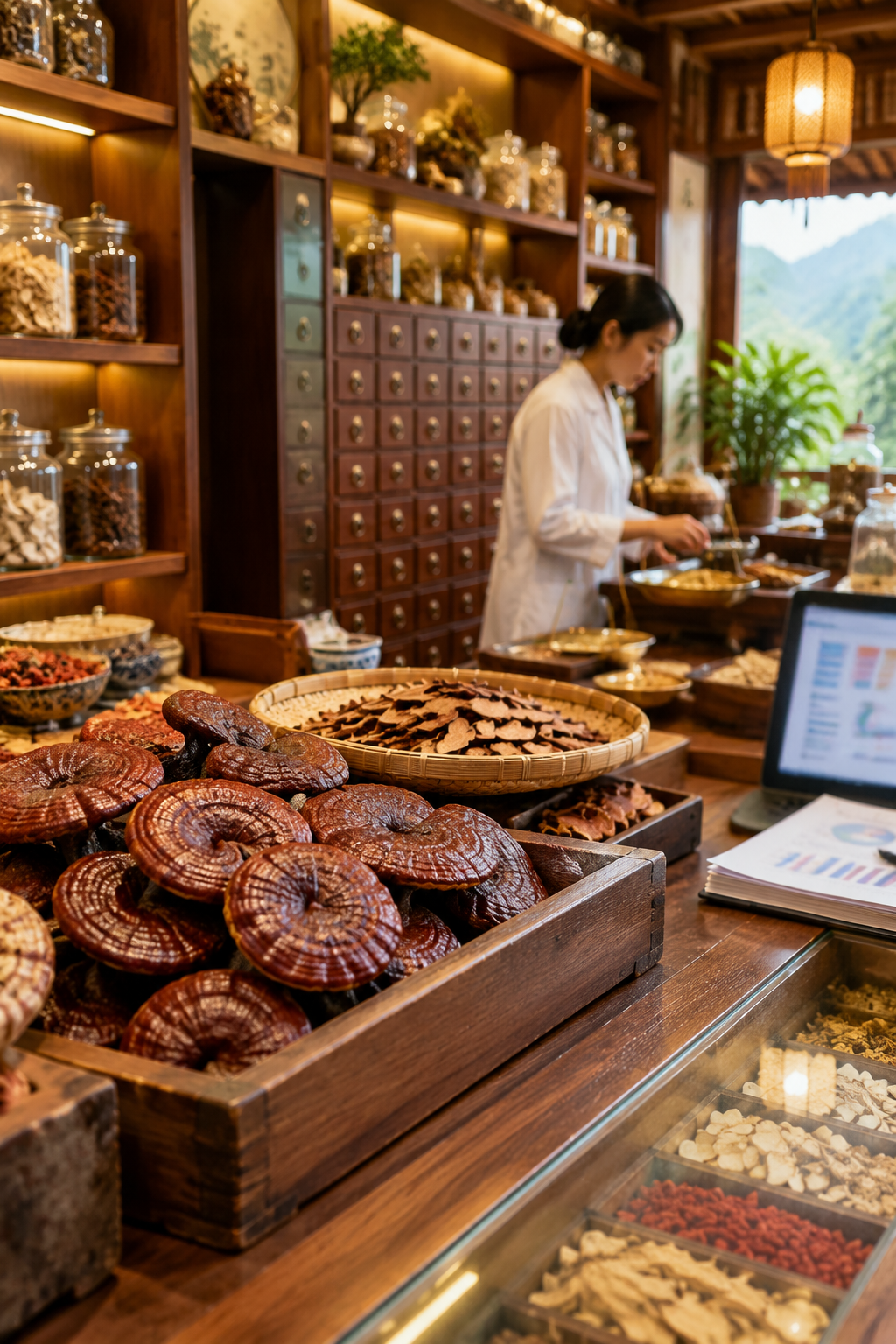
That means lingzhi (reishi), long confined to the medicine cabinet, can now be used lawfully in ordinary food products. For anyone in tea, tonics or retail, the question is no longer whether it can be done, but where to start reading the market.
Four questions readers ask most often.
Is lingzhi not a medicine? Why can it be sold as food?
The answer lies in the catalogue, not in folk opinion.
The line from the Huangdi Neijing — "eaten on an empty stomach it is food, eaten by the sick it is medicine" — is the earliest footnote to the idea of medicine-food homology (popular science article, Langfang Hospital of Traditional Chinese Medicine, published 30 September 2026). As of May 2025 the catalogue had reached 106 items, and lingzhi is on it.
According to industry reporting from Lishui, lingzhi has been included in the food-and-medicine substances catalogue; trade press roundups also group it with huangqi (astragalus), dangshen (codonopsis), maidong (dwarf lilyturf), tianma (gastrodia) and xiyangshen (American ginseng) as mainstream tonic ingredients now cleared for general use in ordinary foods (Huxiu, 2026).
The boundary is equally clear: sanqi (notoginseng), danshen (red sage), heshouwu (fleeceflower root) and fuzi (aconite) are strictly prohibited as additives in ordinary food. If it is on the list, it can be made into products as an ingredient; if it is not, leave it alone.
Lingzhi is said to be judged by its origin. How do you actually assess that?
Look at three things: the region's public brand, traceable proof of origin, and whether the variety is covered by the pharmacopoeia.
Lishui is hard to avoid as a reference point. Its forest coverage is 80.81 per cent, it has 2,478 species of wild medicinal plants — 85.2 per cent of Zhejiang province's total — and more than 500 dominant wild medicinal herbs, earning it the name "treasure house of medicinal plants in East China".
In April 2025 Lishui launched the "Lishui Nine Flavours" regional public brand, covering nine local botanicals: lingzhi, tiepishihu (dendrobium), sanyeqing (tetrastigma), huangjing (polygonatum), fupenzi (raspberry), Chuzhou white lotus, shiliangcha, yiyiren (coix seed) and huangju (imperial chrysanthemum). The first batch comprised 21 member companies and 44 licensed products (Tencent News).
The value of a regional public brand is that it turns "authentic origin" from an adjective into a list you can check. When buying, trusting the list is more reliable than trusting the story.
The same lingzhi: what separates the growing area from the shelf?
Post-harvest processing and storage — the least visible and most expensive stretch.
One rule has been repeatedly confirmed in Chinese medicinal material processing: sulphur fumigation for preservation and whitening carries a risk of sulphur dioxide residue, so modern compliant processing has largely shifted to sulphur-free physical methods and low-temperature constant-humidity drying, supported by testing for moisture, total ash, sulphur dioxide and heavy metals ("Why the price of chuanbei mu varies so widely", Huazisheng).
Storage and graded packaging are a second hurdle. Take the Yellow River beach jujubes of Wubao, Shaanxi — also within the food-as-medicine category. Local jujube cultivation there spans more than three thousand years, and reporting notes that the fruit depends heavily on cold-chain storage, that storage facilities are insufficiently standardised, that graded packaging is limited, that export channels are fragmented, and that continuous autumn rain easily causes the fruit to split and rot (Sina Finance). Good natural endowments do not equal good commercialisation.
For lingzhi, Lishui's approach is to push into deeper processing: the municipal agricultural investment group has signed cooperation framework agreements with the municipal central hospital, the municipal people's hospital and the municipal hospital of traditional Chinese medicine, and has launched products including lingzhi spore powder, a lingzhi vitality drink and blended incense beads; the city has developed 81 medicinal-diet dishes and is working to include them in the "One Hundred Counties, One Thousand Bowls" dish system (Tencent News).
Traditionally, lingzhi has been used across regions as an ingredient in soups, decoctions and cooked dishes, part of folk dietary culture — this describes how it is eaten, nothing more.

For someone entering now, what do the numbers look like?
The conclusion first: this is a track with real scale, and rising barriers.
Lishui's traditional Chinese medicine and health industry currently has 108 above-scale enterprises, of which 31 have output value above 100 million yuan and 18 are "specialised, refined, distinctive and innovative" small and medium enterprises; the city's medicinal herb planting area exceeds 350,000 mu, a net increase of 42,000 mu over three years, spread across 154 townships; from January to July 2026, above-scale enterprises recorded industrial output value of 9.743 billion yuan; over three years the city has attracted 72 major projects with total investment of 26.262 billion yuan (Tencent News).
The other side is tightening. Fifty new national food safety standards have taken effect, raising requirements for ingredient traceability and compliant marketing, and trade press notes that tighter local supervision has already pushed more than a thousand small workshops out of the market (Huxiu).
Scale is growing and consolidation is happening at the same time.
What this means for operators
First, choose products by checking the catalogue, then proof of origin, and only then the packaging story. Reverse the order and you keep all the risk.
Second, the opportunity at store level is experience. PAKONTONG is a Hong Kong brand with currently just one physical store, at City Balcony in Zhuhai: by day it brews herbal tea fresh, puts chenpi, osmanthus and Longjing into coffee, and serves Chinese whole-leaf tea; at night it switches to herbal craft brews and herbal cocktails. The same ingredients, sold into different occasions at different hours.
Third, the opportunity in retail is the standardised gift box. PAKONTONG's "Twenty-Four Flavours Herbal Tea" comes in six gift boxes in individual small tins, sold on JD.com — putting non-standard herbal ingredients into a form that can be given as a gift and bought again is the last mile of a growing region's story.
Origin sets the floor for ingredients; processing and compliance set the ceiling for the business. The ones who last are never the best storytellers.
Experience store, e-commerce store and mini program support.