
Herbal drinks: 43,200 tea shops closed in a year, while a hospital café sells 300–500 cups a day
China's tea shop sector lost 43,200 outlets in a year, yet a herbal café inside a Shanghai hospital sells 300–500 cups daily. What the contrast means for food-as-medicine operators.
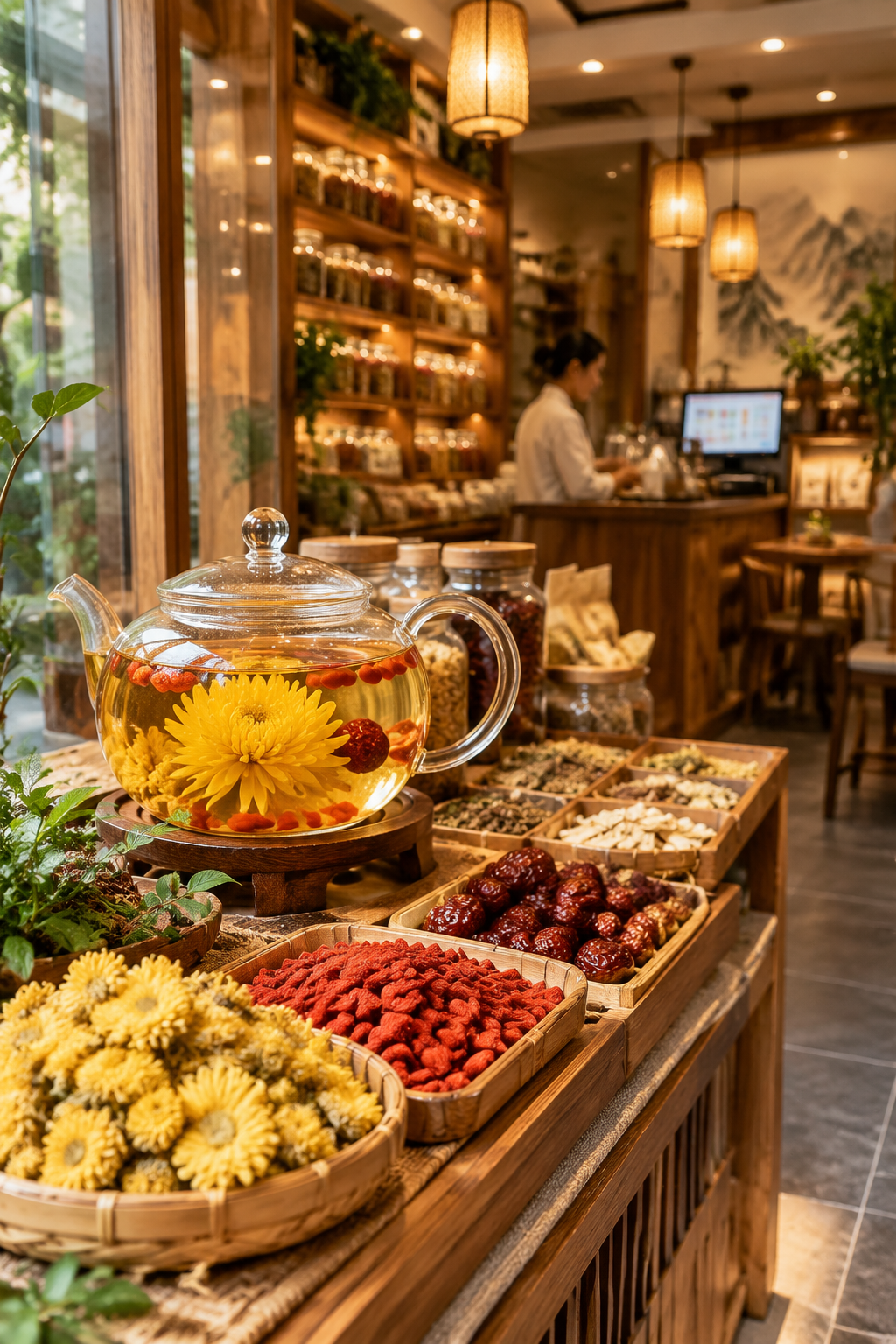
In autumn 2026, two numbers in China's herbal drinks sector pointed in opposite directions. The tea shop industry lost a net 43,200 outlets over the year, while a wellness café inside a Shanghai hospital held steady at 300 to 500 cups a day. For anyone planning a herbal drinks shop, or looking for a channel for food-as-medicine products, that gap is worth more than any trend report.
Move the ingredients out of the back kitchen
The most direct reason for this round of growth is that ingredients became visible.
The supply side is blunt about it. According to information disclosed by Tan Yang Health Supply Chain and republished by Sina Finance, orders for food-as-medicine ingredients such as goji berries, red dates, longan and chrysanthemum grew more than 180% year on year in 2026, and custom flower tea and OEM production for wellness drinks have become two of the hottest directions for new businesses.
Shops are changing in step: clear glass pots boiling tea in view, whole chrysanthemum flowers opening in the cup, grains and beans layered where you can see them. Related check-in posts on Xiaohongshu and Weibo have passed the million mark.
The method comes down to one sentence: put the ingredient display where guests see it the moment they walk in, do the boiling in front of them, and don't chop the whole red date or the whole chrysanthemum and hide it at the bottom of the cup.
The counter-example is easy to spot. A shop whose menu offers only sweetness and temperature options, and where you never see an ingredient from start to finish, is still a milk tea shop in a different skin.
Find the setting before you find the unit
Another change worth studying this year: wellness cafés are opening in places that don't look like coffee locations.
According to Xinmin Evening News, a wellness café has opened inside a Shanghai hospital. The menu runs two lines: herbal coffee drinks built on food-as-medicine ingredients such as chenpi (dried tangerine peel), rougui (cinnamon) and luohanguo (monk fruit), and a series following the 24 solar terms, with recipes updated as the seasons and natural signs change. Daily sales hold at 300 to 500 cups, and the customers are patients and medical staff.
Guizhou has taken a similar approach, tying coffee to geological landscapes such as caves, waterfalls and sinkholes to create "sinkhole coffee", "waterfall coffee" and "forest cliff coffee". In Xinzhai village in Yunnan, visitors pick, process, roast and brew the beans themselves; since the 14th Five-Year Plan period, the village has received more than 200,000 visitors a year on average.
What these three have in common is not the recipe but the setting, which brings its own foot traffic, dwell time and trust. Hospitals, scenic areas, hotels, academies and old-brand pharmacies all tend to build volume more easily than a standard unit in a shopping mall, and the rent structure is entirely different.
Lock in a group of people who were already going to spend a long time in that place, then find a spot beside them. That order saves far more money than signing a lease first and deciding what to sell afterwards.
Store count is no longer the growth story; the single store is
Two sets of 2026 financial results make this clear.
According to Chagee's results, total GMV in the second quarter of 2026 was RMB 7.66 billion, down 5.50% year on year, with Greater China GMV down 9.00% and same-store GMV growth at -16.10%. The company designated 2026 a "year of adjustment and stabilisation", and total operating expenses in the second quarter fell 10.40% year on year.
Guming's interim report shows first-half revenue of RMB 7.47 billion, up 31.90% year on year, with 14,351 stores, average daily GMV per store of RMB 7,800 against RMB 7,600 in the same period a year earlier, and the franchisee exit rate down from 5.33% to 4.31%.
One holds profit by compressing costs; the other props up growth with a small gain per store. Add the industry backdrop of a net loss of 43,200 outlets in a year, and the conclusion is not complicated: how many stores you open is no longer a story anyone can tell. How much revenue one store can hold each day is.

For smaller operators, the metrics worth watching need to change. Your own average daily sales per store, repurchase rate and exit cycle matter far more than how many shops opened next door.
The ingredient itself is cheap; the value sits above it
Fresh osmanthus from Yaoshang village in Suzhou once fell to a purchase price of RMB 2 to 3 per jin. Outside traders bought 70% of the village's fresh osmanthus at low prices, processed it into flavourings and fragrances, and sold it on at dozens of times the price.
What does the same osmanthus look like at the consumer end? Yeye Bupaocha's "Xianning osmanthus" single product sells more than 7.4 million cups a year, with cumulative sales of 16 million cups.
The difference is not the osmanthus. It is product definition, consistency of output and brand. Whoever builds those three takes that premium.
What this means for operators
The signal from this wave is not about the concept of "more wellness". It is about three concrete things: whether the ingredients can be seen, whether the setting is chosen well, and whether the single-store numbers add up.
When selecting products, first check whether the ingredients suit visible display and whether the recipe leaves room for seasonal updates, then check whether supply is stable. When opening a store, prioritise locations that bring their own foot traffic and dwell time rather than crowding into commercial districts. If you are already operating, move your attention from comparing store counts back to the sales per square metre and repurchase rate of your own shop.
PAKONTONG offers one reference point. It currently has only one physical store, in City Balcony, Zhuhai. By day it serves freshly boiled herbal tea, new-style Chinese coffee (with chenpi, osmanthus and longjing tea folded into coffee) and Chinese whole-leaf tea; at night it switches to herbal craft brews and herbal cocktails. On the product side there is the "Twenty-Four Herbal Teas" gift box series of six varieties in individual small tins, currently sold on JD.com. Putting "visible herbs" and "drinking with the seasons" inside one shop is one way to walk this road, and a sample worth measuring yourself against.
The businesses that last are usually not the ones with the most esoteric recipes, but the ones that display their ingredients clearly, choose their setting carefully and know their single-store numbers inside out.
Experience store, e-commerce store and mini program support.